The fire is out, the house is aired, and the books still smell. You open a favourite novel and the smoke comes straight off the pages, even though the shelf it sat on barely looks touched. Knowing how to get smoke smell out of books is one of the most common questions we hear after a Calgary house fire, because books are the belongings people are least willing to let go of, and they are also one of the hardest things in a home to deodorize.
Paper is porous. It pulls smoke particles and odour molecules deep into its fibres, and a closed book traps them there. Wiping the cover does nothing for the pages, and the wrong cleaning method can leave permanent grey smears. This guide explains what you can safely do at home, what makes the odour worse, how professionals treat smoke-damaged books, and how to tell which books are worth restoring.
Table of Contents
- Why books hold on to smoke smell
- First, check what you are dealing with
- How to remove soot without smearing it
- How to get smoke smell out of books at home
- What not to do
- Books that got wet during firefighting
- How professionals treat smoke-damaged books
- Why Calgary Contents is the right choice for smoke-damaged books
- Frequently Asked Questions
Key Takeaways
- Paper is porous, so smoke odour sits inside the pages, not just on the cover, and surface wiping will not remove it.
- Remove loose soot first with a dry chemical sponge using a gentle dabbing motion; wiping or using water turns soot into permanent smears.
- To get smoke smell out of books at home, fan them open in a sealed container with activated charcoal or baking soda that does not touch the pages, and allow days to weeks.
- Books that were also soaked by firefighting water need drying or freezing within 24 to 48 hours, before odour, because mould is the bigger threat.
- Professional treatment uses controlled deodorization chambers, ozone and hydroxyl technology, which reach odour a household method cannot.
Why books hold on to smoke smell
Smoke is a mix of fine particles and gases, and paper is almost perfectly designed to catch both. The fibres in a page are full of tiny gaps, and the particles and odour molecules that drift into a room during a fire settle into those gaps and bond to the paper. Because a closed book is a tightly packed block of hundreds of pages, the odour gets trapped between them with nowhere to go. That is why a book can smell strongly months later even when the room around it has been cleaned.
The type of fire matters too. A fast, hot fire tends to leave dry, powdery soot that brushes off more easily. A slow, smouldering fire or a kitchen fire leaves oily, sticky residue that clings to paper and cloth covers and carries a sharper, more persistent odour. Synthetic materials burning in a modern home add their own chemical smell. Wildfire smoke, which Calgary has seen plenty of in recent summers, deposits finer particles over a longer period; our guide to wildfire smoke damage to belongings covers that situation in detail.
First, check what you are dealing with
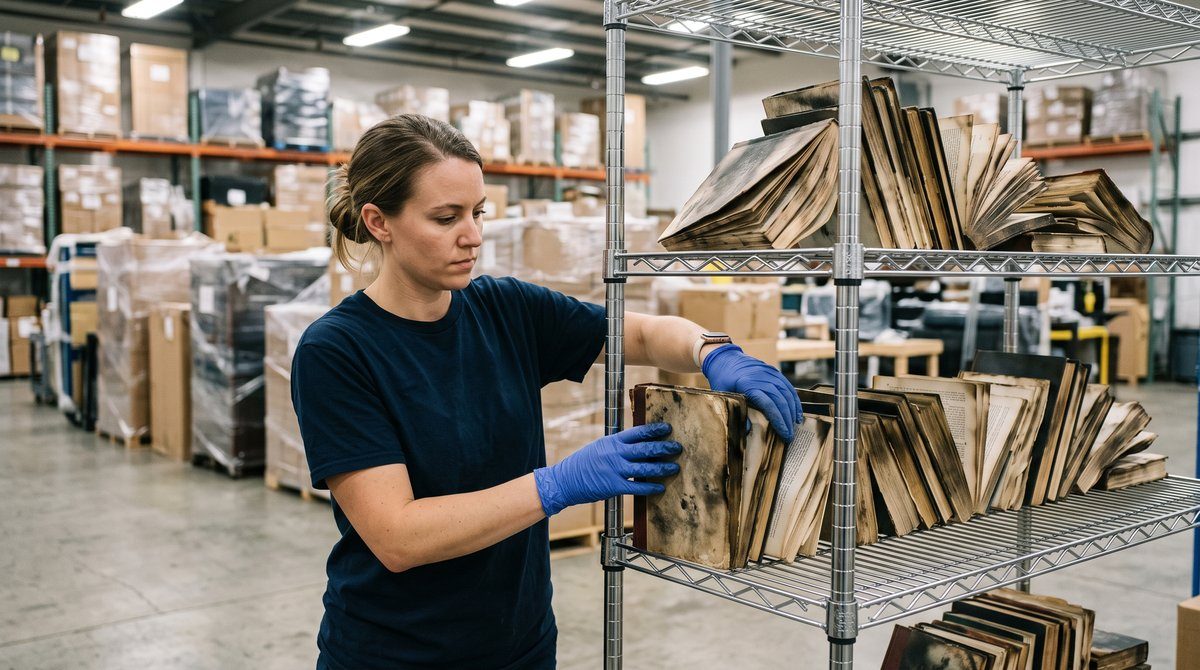
Before you treat anything, sort the books by condition. The right approach depends on whether the problem is odour alone, odour with soot, or odour with water damage, and on how much the book is worth to you.
| Condition | What you see | Best approach |
|---|---|---|
| Odour only | Clean covers and pages, smoky smell when opened | Home deodorizing method below |
| Light soot | Grey film on the top edge and spine | Dry sponge soot removal, then deodorize |
| Heavy or oily soot | Dark, sticky residue on covers and page edges | Professional cleaning |
| Wet from firefighting | Damp, swollen or warped pages | Dry or freeze within 24 to 48 hours |
| Charred or heat damaged | Scorched edges, brittle or curled pages | Professional assessment; many are not restorable |
| Rare or valuable | Any damage to an antique, signed or collectible book | Do not treat at home |
If the fire was significant, photograph the books where they sit before you move them. Books are part of your contents claim, and your insurer will want to see their condition before any cleaning. Our photo inventory service documents everything item by item for exactly this reason.
How to remove soot without smearing it
Soot comes off before odour treatment begins, and it has to come off dry. Soot contains oils, and the moment it meets moisture, whether that is water, a damp cloth or even your fingers, it smears into the fibres and becomes a stain.
- Work outdoors or in a ventilated space, wearing nitrile gloves so skin oils do not transfer to the book.
- Hold the book firmly closed so soot cannot fall between the pages while you work on the edges.
- Use a dry chemical sponge, sometimes sold as a soot sponge. Dab and lift rather than rub, and turn the sponge to a clean face often.
- Clean the top edge of the pages first, then the spine, then the covers. The top edge is where most soot settles on a shelved book.
- Remove paper dust jackets and clean them flat and separately; they are thinner than the cover and tear easily.
The Canadian Conservation Institute’s guidance on the basic care of books describes the same gentle dry approach using smoke sponges and soft erasers on stable bindings. If soot is thick, oily or ground into cloth covers, stop at this step and get the book assessed; heavy residue needs professional cleaning, and our post on soot cleanup for Calgary homeowners explains why DIY scrubbing often makes it worse.
How to get smoke smell out of books at home
For books with odour but little or no soot, the goal is to expose as much page surface as possible to fresh air and to something that absorbs odour. It works, but it is slow, and heavily affected books may improve without ever fully clearing.
- Air them out first. Stand books upright with the covers open and pages fanned in a dry, well-ventilated room away from direct sun. A fan moving air across them speeds things up. Give this a few days before trying anything else; it removes a surprising amount of odour on its own.
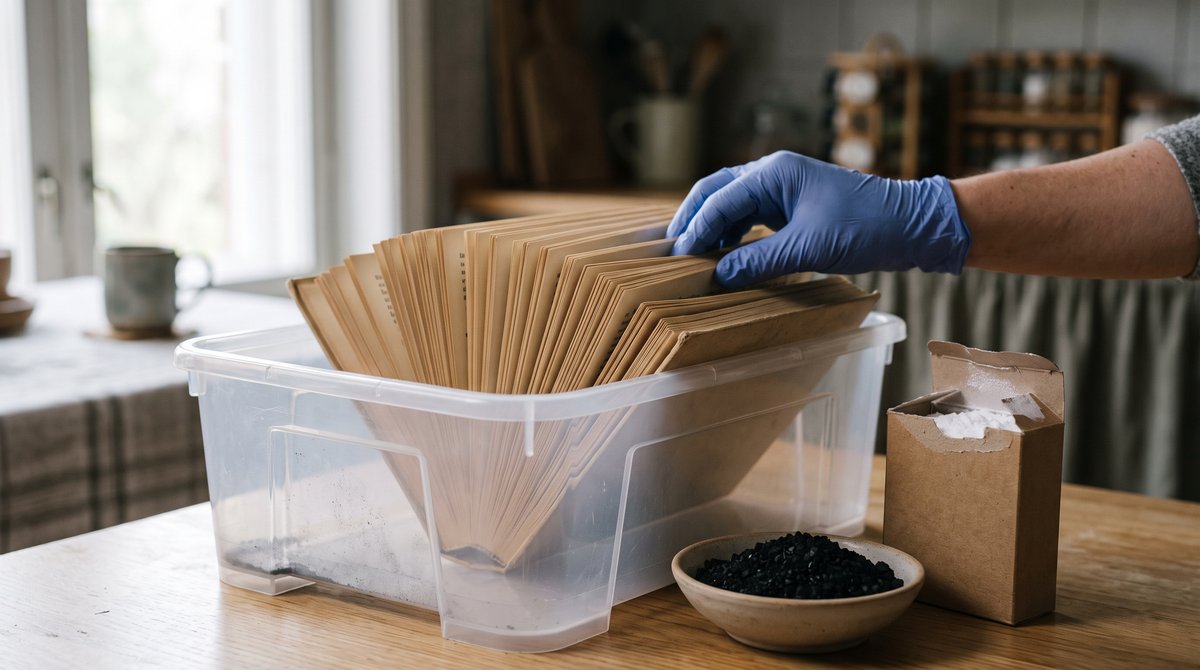
- Move on to an absorber. Place a fanned-open book in a large lidded plastic tub with a shallow dish of activated charcoal or baking soda beside it. The absorber must not touch the pages; baking soda in particular can leave residue on paper.
- Seal it and wait. Close the lid and leave it for several days, then check the odour. Replace the charcoal or baking soda every week, since it stops working once it is saturated.
- Repeat as needed. Mild odour often clears in one to two weeks. Strong odour can take several rounds over a month or more.
Calgary’s dry climate is an advantage here. Low indoor humidity means books air out without the mould risk you would face in a damper city, as long as they were never wet to begin with. For a broader look at which household items respond to this kind of treatment, see what can and can’t be saved after smoke damage.
A whole bookshelf that smells of smoke? Calgary Contents restores books alongside the rest of your belongings, with deodorization equipment built for exactly this. Call (403) 407-0208 for an assessment.
What not to do
Most permanent damage to smoke-affected books comes from well-meaning cleanup. Avoid these:
- Wiping with a damp cloth. Water drives soot into the paper and cloth and leaves grey streaks that cannot be removed.
- Air fresheners and fabric sprays. They mask the odour for a few hours, add moisture and chemicals to the paper, and the smoke smell returns.
- Dryer sheets between the pages. A popular tip, but the fragrance oils can stain and transfer onto the paper.
- Leaving books in direct sun. Sunlight fades covers and makes paper brittle faster than it clears odour.
- Buying a home ozone machine. Ozone is effective in controlled professional settings, but it is a respiratory irritant, it can degrade some materials with repeated exposure, and it should never be run in an occupied space.
Books that got wet during firefighting
After a house fire, many books are damaged by the water used to put it out as much as by the smoke. If your books are damp, swollen or warped, the priority changes completely: mould can begin growing on wet paper within 24 to 48 hours, and a mouldy book is a much bigger problem than a smoky one.
Deal with the water first. Books that are only slightly damp can be air-dried standing upright with pages fanned. Books that are soaked should be placed in freezer bags and frozen, which stops mould growth and buys time until they can be dried properly. Do not try to deodorize a wet book; the smoke treatment comes after it is fully dry. Our guide to document restoration after water damage walks through freeze-drying, which is the professional method for water-damaged books and papers.
How professionals treat smoke-damaged books
Home methods rely on time and passive absorption. Professional contents restoration reaches odour inside the paper using equipment that works in a controlled space, following the approach set out in the IICRC S700 standard for fire and smoke damage restoration.
- Inventory and assessment. Each book is documented and assessed for soot type, heat damage and moisture before anything is cleaned.
- Dry soot removal. Covers, spines and page edges are cleaned with dry methods matched to the binding material.
- Deodorization in a controlled space. Books are opened and arranged on racks so air circulates, then treated with hydroxyl technology or ozone in a sealed room that no one occupies during treatment.
- Verification. Books are checked for remaining odour and treated again if needed before being returned.
For a comparison of the main deodorization methods, our post on fogging versus traditional cleaning explains when each one is used. Books that are charred, brittle from heat or heavily contaminated may not be restorable at all; those are documented for your insurance claim so you are compensated for them.
Why Calgary Contents is the right choice for smoke-damaged books
Calgary Contents specializes in restoring the belongings inside a home after a fire or flood, and books are handled as part of that work rather than as an afterthought. Our team holds IICRC certifications including fire and smoke restoration, and our deodorization and decontamination service uses hydroxyl technology, ozone treatment and fogging to remove smoke odour from items a household method cannot reach.
Items that need intensive treatment are brought to our Calgary facility, and anything that cannot be restored is documented for your insurance claim. We serve Calgary, Rocky View County, Airdrie, Beiseker, Chestermere, Cochrane, Crossfield and Irricana, and our contents cleaning and restoration service covers the rest of your home’s belongings alongside the books.
Do not let smoke odour cost you a book collection. Talk to Calgary Contents about restoring smoke-damaged books and the rest of your belongings. Call (403) 407-0208 or contact us online.
Conclusion
Knowing how to get smoke smell out of books comes down to patience and a light touch. Sort them by condition, lift the soot off dry with a chemical sponge, then air them out and let activated charcoal or baking soda do the slow work in a sealed container. Avoid water, sprays and sunlight, and deal with any wet books before the odour, because mould is the more serious threat. Most lightly affected books recover. For heavy soot, stubborn odour, water-damaged books or anything valuable, professional deodorization reaches the odour inside the paper that time and baking soda cannot.
Frequently Asked Questions
How long does it take to get smoke smell out of books?
Mild odour usually clears in one to two weeks of airing and treatment with activated charcoal or baking soda in a sealed container. Heavy odour can take a month or more of repeated rounds, and some books never fully clear at home. Professional deodorization in a controlled chamber is much faster.
Does baking soda get smoke smell out of books?
It helps. Baking soda absorbs odour when it shares a sealed container with a fanned-open book, but it should sit in a separate dish rather than touching the pages, because it can leave residue on paper. Activated charcoal works the same way and is often more effective.
Can I use a damp cloth to clean soot off a book?
No. Soot contains oils, and moisture drives it into paper and cloth and leaves permanent grey smears. Use a dry chemical sponge with a gentle dabbing motion, and if the soot is thick or sticky, leave it for a professional.
Should I freeze books after a house fire?
Only if they are wet. Freezing stops mould from growing on books soaked by firefighting water and buys time until they can be dried properly. Dry books with smoke odour should not be frozen; they need airing and deodorizing instead.
Are smoke-damaged books covered by home insurance?
Books are usually part of the contents portion of a standard home policy, so restoring or replacing them after a covered fire is typically included, subject to your deductible and limits. Photograph them before cleaning, and keep records of any that cannot be restored. Our contents insurance claim guide explains the process.
When is a smoke-damaged book not worth saving?
Books that are charred, brittle from heat, mouldy, or heavily coated in oily soot are often not restorable, and inexpensive paperbacks may cost more to restore than to replace. Rare, signed or sentimental books are worth a professional assessment before you decide.