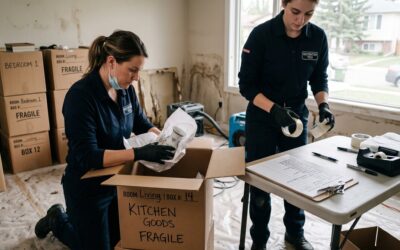
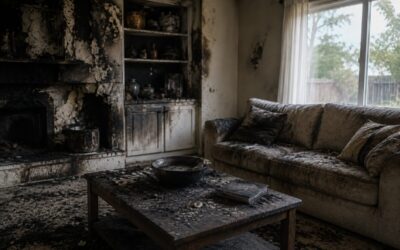
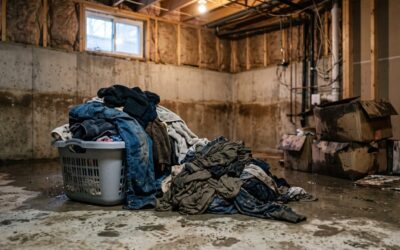
Wildfire smoke damage to belongings in Calgary and Rocky View County looks and behaves differently from smoke damage after a house fire — and the confusion between the two is why so many families throw out things that could have been saved, or hold onto items that are quietly making the air in their home worse. Between the Jasper wildfires of 2024, the recurring plumes from British Columbia every summer, and the closer-to-home grass and brush fires across southern Alberta, every wildfire season leaves foothills and prairie households wondering what to do about the smell, the film on the surfaces, and the sofa that just doesn’t feel right anymore.
This guide breaks down what wildfire smoke actually does to household belongings, category by category — soft goods, hard goods, electronics, documents, and heirlooms. You’ll get a straight save / restore / discard triage table, a plain-language explanation of the three professional treatments that actually work (hydroxyl, ozone, and HaloFog), and a realistic look at what Alberta home insurance policies do and don’t cover when the fire was never in your building.
Table of Contents
- How Wildfire Smoke Damage Differs from House Fire Smoke
- What Wildfire Smoke Does to Soft Goods
- What Wildfire Smoke Does to Hard Goods
- What Wildfire Smoke Does to Electronics
- Photos, Documents & Irreplaceable Heirlooms
- The Save / Restore / Discard Triage Table
- Hydroxyl, Ozone & HaloFog: The Three Professional Treatments
- Wildfire Smoke Damage & Alberta Home Insurance
- Frequently Asked Questions
- Get Help with Wildfire Smoke Damage in Calgary & Area
How Wildfire Smoke Damage Differs from House Fire Smoke
Both events leave smoke on your belongings, but the chemistry, the particle size, and the pattern of deposit are all different. Getting this right matters because the wrong cleaning approach for the wrong type of smoke residue can make the damage permanent.
House fire smoke is the product of burning synthetic materials — plastics, foam, adhesives, treated wood, wiring insulation, upholstery. It produces oily, acidic, heavy soot that settles thickly on visible surfaces near the fire and works its way into porous materials as it cools. The particles are relatively large, the acidity is high, and the concentration on surfaces is intense. This is why after a kitchen or structure fire you see obvious black staining on walls, ceilings, and any items in the affected zone.
Wildfire smoke is the product of burning organic material — trees, grasses, brush, sometimes buildings in the fire path. The combustion is generally more complete, the particles are much smaller (many are ultrafine, under 2.5 microns), and the smoke travels tens or hundreds of kilometres before it reaches your Calgary home. What arrives is a fine, dry, evenly distributed haze that seeps in around every window seal, HVAC intake, and door gap. Instead of a visible black stain in one room, you get a subtle grey-brown film on every surface in every room — plus that unmistakable campfire odour trapped in every soft surface in the house.
The ultrafine particle size is the key. Wildfire smoke particles penetrate into fabric fibres, mattress interiors, book pages, HVAC ductwork, and the housings of electronics rather than sitting on top of them. Surface wiping with a rag and a spray bottle addresses maybe 10% of the actual contamination. The other 90% is embedded in materials that need to be treated with equipment most homeowners don’t have — which is what the rest of this guide is about.
What Wildfire Smoke Does to Soft Goods
Soft goods — clothing, bedding, upholstered furniture, curtains, area rugs, pillows, mattresses, plush toys — are the biggest reservoir of wildfire smoke odour in a Calgary home. Every fibre acts like a tiny sponge, holding onto the volatile organic compounds (VOCs) that cause the smell. Weeks after the smoke event has passed and the air has cleared, your family’s sweaters and your kids’ stuffies still smell faintly like a bonfire because the odour molecules are physically bonded to the fibres.
Domestic washing with laundry detergent often makes surface odour worse before it makes it better — the water opens the fibres, releases some of the trapped VOCs into the air, and can drive residual smoke particles deeper into the fabric. That’s why the “wash it twice and hope for the best” approach so often fails. Wildfire-smoked soft goods need to be treated with commercial ozone or hydroxyl processing before laundering, then laundered with an odour-neutralizing additive, then re-tested for residual smell.
The worst-affected items are usually the ones with the most surface area per pound of weight: down duvets, wool blankets, curtains, sheepskin rugs, and anything with a heavy stuffed interior. Mattresses in particular are almost impossible to fully clean at home — the smoke penetrates the foam core and stays there.
What Wildfire Smoke Does to Hard Goods
Wood, metal, glass, ceramic, and plastic surfaces show wildfire smoke damage differently. Because the residue is dry rather than oily, it usually wipes away with a dry sponge or dry chemical sponge (the yellow “soot sponge” carried by restoration suppliers) — but only if you get to it before it’s had time to absorb humidity and adhere.
What people miss is that the visible film on hard surfaces is only part of the problem. Wildfire smoke etches unfinished wood, discolours light-colour paint over time (an acidic reaction that can take weeks or months to show), and dulls the finish on glossy metal and hardwood. Kitchen cabinets, hardwood floors, granite countertops, and unsealed wood furniture all need proper decontamination — not just a Windex wipe — to prevent long-term damage.
Kitchenware sitting out on counters or in open shelving during a smoke event gets contaminated too. Ultrasonic cleaning restores it faster and more completely than any hand-washing approach — the cavitation bubbles reach into the microscopic pores and crevices that a dishcloth can’t. This is one of the biggest wins Calgary Contents delivers for wildfire smoke jobs: entire sets of dishes, glassware, cutlery, and cookware that would otherwise be replaced come back looking better than they did before the smoke event.
What Wildfire Smoke Does to Electronics
Wildfire smoke and electronics are a slow-motion problem. The ultrafine particles pass through cooling vents, settle on circuit boards, and slowly attract moisture from the air. That moisture combined with the mildly acidic residue creates the perfect condition for corrosion of the tiny solder joints and traces inside the device. A television, computer, gaming console, or stereo receiver that seems fine right after a smoke event can develop intermittent failures — and eventually stop working entirely — weeks or months later.
The best time to address smoke exposure in electronics is right away, before the corrosion cycle starts. The process involves opening the device, cleaning circuit boards with a specialty solvent that displaces water and lifts residue, and treating the housing with hydroxyl or ozone to kill the smell trapped in the plastic. Done properly, most consumer electronics can be saved. Left alone, most gradually fail.
The exception: any electronic that runs hot during a smoke event — a computer that was on, a stereo that was playing, a fridge or freezer with its compressor running — will have drawn much more smoke through its internal air paths than an item that was off. These are the highest-priority items to have professionally cleaned.
Photos, Documents & Irreplaceable Heirlooms
Paper is fibrous, so wildfire smoke settles into it the same way it settles into fabric. Books, family photo albums, scrapbooks, land titles, tax records, sheet music, artwork on paper — all of it absorbs the odour and, more slowly, the acidity that will discolour and embrittle the pages over years.
The good news is that document and photo restoration for smoke damage (as opposed to water damage) is relatively gentle. Individual pages are cleaned with soft dry sponges, treated with a controlled ozone or hydroxyl chamber to remove trapped odour, and re-boxed in acid-free archival storage. Vintage photographs on fibre-based paper respond particularly well. Framed art benefits from having the glass, backing, and mat replaced — the frame usually gets to stay.
Do not try to clean smoked photos or documents at home with any kind of liquid. Water, cleaning sprays, and even rubbing alcohol will destroy the emulsion on photos and dissolve inks on documents. Bag them and wait for a professional assessment.
The Save / Restore / Discard Triage Table
Here’s a straightforward category-by-category guide to what typically responds well to wildfire smoke restoration, what usually needs professional treatment, and what’s rarely worth saving. This applies to indirect wildfire smoke exposure — the situation where smoke drifted into a home whose structure was not damaged. Direct fire exposure changes the equation substantially.
| Item Category | Save (DIY) | Restore (Professional) | Discard |
|---|---|---|---|
| Everyday clothing (cotton, poly) | Rare | ✅ Usually restorable | — |
| Dry-clean-only garments | — | ✅ Yes (specialty laundering) | — |
| Down duvets, wool blankets | — | ✅ Yes (ozone + laundering) | — |
| Upholstered furniture | — | ✅ Usually restorable | Rarely |
| Mattresses | — | Sometimes (depends on age & depth of exposure) | Often, if heavy exposure |
| Curtains, drapery | — | ✅ Yes | — |
| Area rugs (wool, silk, synthetic) | — | ✅ Yes (specialty wash + ozone) | — |
| Dishware, glassware, cutlery | — | ✅ Yes (ultrasonic) | — |
| Cookware (pots, pans) | Light exposure | ✅ Yes (ultrasonic) | — |
| Hardwood furniture | Light exposure only | ✅ Yes | Rarely |
| Electronics (was ON during event) | — | ✅ Yes (priority) | Only if already failing |
| Electronics (was OFF during event) | Light exposure only | ✅ Recommended | — |
| Books & documents | — | ✅ Yes (chamber treatment) | Only if crumbling |
| Photos & albums | — | ✅ Yes | — |
| Framed artwork | — | ✅ Yes (art conservator or specialist) | — |
| Perishable food (fridge/freezer) | — | — | ❌ Discard |
| Non-perishable food in sealed packaging | Wipe exterior; discard opened items | — | Any opened package |
| Cosmetics, medicines, personal care | — | — | ❌ Discard |
| HVAC filters | — | — | ❌ Discard & replace |
Two important notes on this table. First, “restore” almost always beats “replace” on cost — a professional pack-out of a wildfire-smoked household typically restores 80–95% of the affected contents for a fraction of what full replacement would cost. Second, food, medicine, and cosmetics get discarded not because the containers are contaminated but because ultrafine smoke particles can enter through seals, threads, and pump mechanisms; the risk isn’t worth the savings.
Hydroxyl, Ozone & HaloFog: The Three Professional Treatments
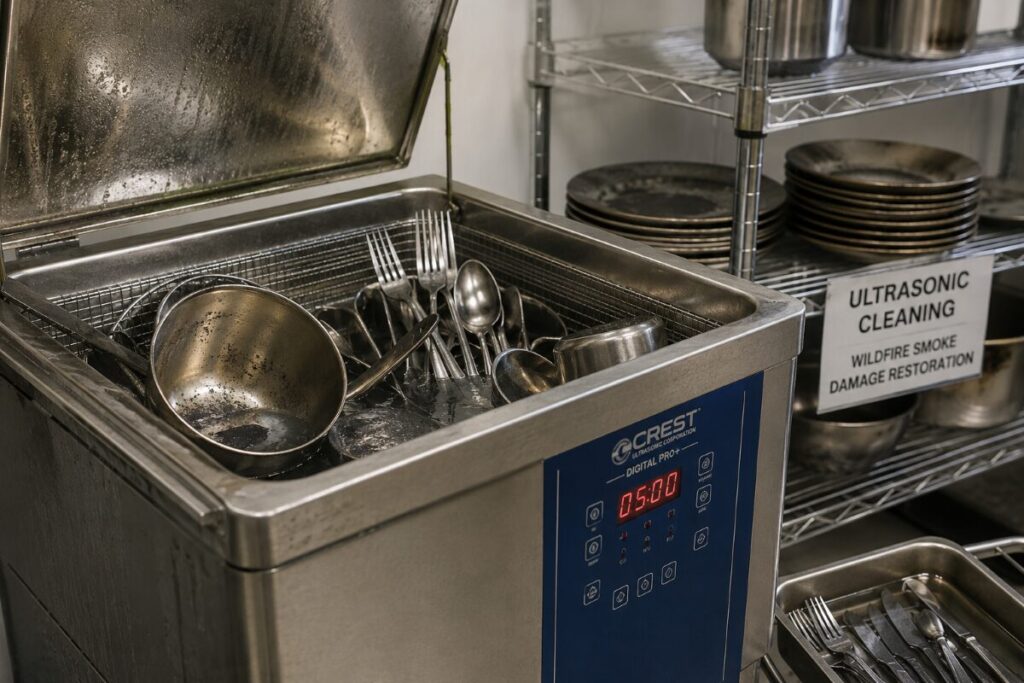
Three technologies do the heavy lifting on wildfire smoke odour removal. They work in different ways, on different materials, and for different reasons. A good contents restoration workflow uses all three depending on the item.
Hydroxyl Generators
Hydroxyl radicals occur naturally in the atmosphere and neutralize odour molecules by breaking their chemical bonds. Commercial hydroxyl generators produce these radicals in a controlled way using UV light and airflow. The big advantage: hydroxyl is safe to run in occupied spaces — people, pets, and plants can stay in the room. The downside: it works slowly, so it’s usually deployed for days at a time on the whole structure or the contents zone.
Ozone Chambers
Ozone (O₃) is a highly reactive form of oxygen that oxidizes odour molecules, breaking them down permanently. Ozone treatment is much faster than hydroxyl — hours instead of days — but it’s not safe for people, pets, plants, or certain sensitive materials (rubber, some plastics, some artwork). That means it happens in a sealed chamber at a restoration facility, not in your home. Ozone is the workhorse treatment for smoked clothing, textiles, upholstery, books, and hard goods that can go into the chamber.
HaloFog / Thermal Fogging
Thermal fogging uses a heated deodorizing compound that mimics the behaviour of smoke — the fine “fog” penetrates the same materials smoke penetrated, chemically binding with and neutralizing the trapped odour molecules. HaloFog is a modern refinement of this approach using a proprietary compound. It’s especially effective inside HVAC ductwork, attic spaces, wall cavities, and other places smoke reached that you can’t practically clean by hand.
Because each treatment reaches different types of contamination, a comprehensive wildfire smoke restoration usually combines them — ozone chamber on the packed-out contents, hydroxyl on the structure, and thermal fogging where residual odour persists after the first two rounds.
Wildfire Smoke Damage & Alberta Home Insurance
Wildfire smoke damage to Calgary and Rocky View County belongings is usually covered under a standard Alberta home insurance policy, because smoke damage from an external fire falls under the “sudden and accidental” perils most policies list. But usually is not always, and there are some patterns worth knowing.
Some Alberta insurers treat wildfire smoke as a covered peril automatically. Others require you to demonstrate a specific damaging event within a defined period — not just “the air was smoky for two weeks.” A few policies exclude smoke damage that occurs when there’s no direct property damage from the fire itself. Read your policy declarations or call your broker to confirm before you assume coverage.
Where covered, the claim process for wildfire smoke belongings runs the same as any other contents insurance claim in Calgary: notify the insurer, get an inventory built, submit Proof of Loss, and either restore or replace. Because wildfire smoke damage is often subtle and cumulative, some homeowners wait too long to open a claim and then have trouble linking the damage to a specific event. If you had visible smoke in your home during a wildfire episode, document it with dated photos and start the conversation with your insurer while the connection is fresh.
Frequently Asked Questions
Will the wildfire smoke smell in my Calgary home go away on its own?
Faint exposure sometimes clears on its own with weeks of open windows and running the furnace fan through a fresh filter. Moderate to heavy exposure — where the smell is still noticeable after a month and you can see grey-brown film on light-colour surfaces — usually will not clear without professional intervention. The odour molecules are chemically bonded to porous materials and need to be broken down, not aired out.
Can I clean wildfire-smoked belongings myself with vinegar or baking soda?
For light exposure on hard, non-porous surfaces (glass, tile, sealed countertops), a mild vinegar solution works fine. On soft goods, porous surfaces, electronics, and anything with sentimental value, DIY methods usually underperform and can make things worse — driving residue deeper into fibres, damaging finishes, or missing the odour trapped in materials you can’t reach. The rule of thumb: if you can still smell smoke after the surface looks clean, DIY isn’t working.
Is wildfire smoke residue in my home a health risk?
Yes, especially for children, seniors, and anyone with asthma or a cardiovascular condition. Wildfire smoke contains fine particulate matter (PM2.5), volatile organic compounds, and traces of burned building materials when the fire path included structures. Residue on soft goods and in HVAC systems can continue to release these into the air of your home for weeks after the smoke event. Health Canada and Alberta Health Services both recommend prompt cleaning of interior surfaces and replacement of HVAC filters after a significant smoke exposure.
How much does wildfire smoke contents cleaning cost in Calgary?
Costs vary by the scope of exposure, the volume of contents, and the mix of materials involved. A localized smoke event affecting one or two rooms of a Calgary or Airdrie home might be a few thousand dollars of contents work. A whole-house heavy exposure with a full pack-out to our facility can run tens of thousands. In almost every case, the professional cleaning cost is a fraction of what full replacement of the affected belongings would be — which is why insurance carriers generally prefer restoration over cash-out on wildfire claims.
How long does wildfire smoke restoration take?
For a moderate residential job — full pack-out, ozone chamber treatment, laundering, ultrasonic cleaning of kitchenware, and hydroxyl treatment of the structure — expect two to four weeks from start to finish. Simpler jobs move faster. Larger jobs, or jobs with a lot of specialty items (art, photographs, electronics), take longer. Your restoration team should give you a clear timeline after their initial assessment.
Do I need to leave my home while wildfire smoke cleanup is happening?
Usually you can stay. Hydroxyl treatment is safe with people in the space. Thermal fogging requires you to be out for the treatment window (usually a few hours) and then reventilated before you return. Ozone treatment happens at the restoration facility, not your home. Some families choose to be out during the pack-out phase just to reduce the disruption. Additional Living Expenses under your home policy usually cover the hotel and meals if displacement is needed.
Get Help with Wildfire Smoke Damage in Calgary & Area

Wildfire smoke damage to belongings in Calgary, Airdrie, Cochrane, Chestermere, Crossfield, Irricana, Beiseker, and across Rocky View County is what we do every wildfire season. Our team travels out from our Calgary facility with the equipment, packing materials, and inventory system to triage what needs professional attention, restore what can be saved, and give you honest advice on what isn’t worth the effort.
If you’re smelling smoke in your home weeks after the last wildfire episode, seeing grey-brown film on your light-colour walls or ceilings, or worried about an item you love but aren’t sure can be saved — call us before you throw anything out. A no-obligation contents assessment usually takes 30 to 60 minutes and gives you a clear picture of what’s realistic.
📞 Call (403) 407-0208 for wildfire smoke contents assessment across Calgary and area, or request a quote online.
Related reading: The complete Calgary contents insurance claim guide · Soot cleanup Calgary — what to save vs. throw out · Contents restoration vs. replacement in Calgary · Mould damage to belongings in Calgary