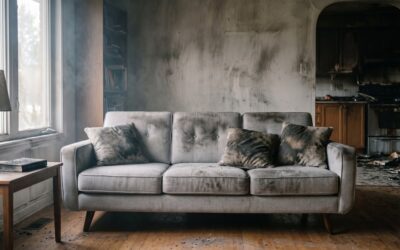
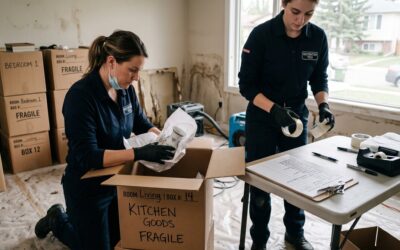
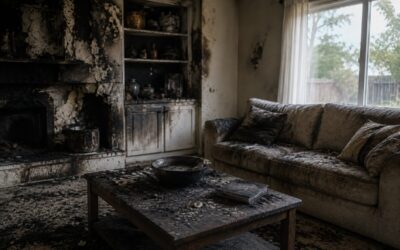
A commercial pack-out moves a business’s contents, such as furniture, equipment, records and stock, out of a damaged space so it can be cleaned and the building repaired. Done well, it protects what can be saved, documents what cannot, and gets the most important items back first so the business can reopen sooner. The difference from a home pack-out is scale, the value of the equipment and records involved, and the cost of every day the doors are closed.
This guide explains how a commercial pack-out works after a fire or flood in Calgary, what to prioritize, how to protect records and electronics, and how to reduce downtime.
Key Takeaways
- A commercial pack-out protects contents and lets repairs start sooner.
- Prioritize what you need to reopen: records, IT, key equipment and stock.
- Confidential records need secure handling and storage.
- Never power up electronics after smoke or water damage until they are checked.
- Staged pack-back can get you open before every item has come back.
Table of Contents
- How a commercial pack-out differs from a home
- What to prioritize
- Contents by type of business
- Restaurants and commercial kitchens
- Stock and inventory: restore or write off?
- Protecting records and confidential files
- Computers, servers and equipment
- Staff belongings and personal items
- The commercial pack-out process
- Reducing downtime
- Keeping everyone informed
- If you lease your space
- Commercial insurance and contents
- After you reopen
- Planning ahead: a simple pre-loss plan
- How Calgary Contents helps businesses
- Frequently Asked Questions
How a commercial pack-out differs from a home
A home pack-out is mainly about furniture, clothing and keepsakes. A business has more items and more kinds of items, and some of them, like servers, specialist equipment and client files, are hard to replace quickly. There are also more people involved: owners, managers, staff, the landlord, other tenants and often more than one insurer. And every day closed costs money.
That changes how the job is planned. The aim is not only to protect contents but to sequence the work so the business can operate again as soon as possible.
What to prioritize
- Records and data: client files, contracts, financial records and backups
- IT and electronics: computers, servers, phones and point-of-sale systems
- Equipment you need to reopen: tools, machines and specialist gear
- Stock and inventory: separate what can be restored from what is a loss
- Furniture and fixtures: desks, seating, shelving and displays
- Décor and personal items: art, plants and staff belongings
Agree on this list with your contents company before the pack-out starts, so the crew knows what goes first and what comes back first.
Contents by type of business
| Business | Typical priority contents | Special considerations |
|---|---|---|
| Office | Computers, servers, files, furniture | Confidential records and data |
| Retail | Stock, fixtures, displays, point-of-sale | Separating sellable stock from damaged stock |
| Restaurant | Kitchen equipment, smallwares, dining furniture | Food safety; grease and protein residue after kitchen fires |
| Clinic or professional office | Equipment, patient or client records | Privacy requirements for records |
| Warehouse | Stock, equipment, racking contents | Volume and access for trucks |
Restaurants and commercial kitchens
Kitchen fires leave greasy, protein-based residue that is hard to see and has a strong odour. Food and single-use supplies exposed to smoke, heat or water are usually discarded. Smallwares such as utensils, pans and serving pieces can often be cleaned, and ultrasonic cleaning reaches residue in detailed items. Dining furniture, linens and décor need cleaning and deodorizing before the room can reopen. Large cooking equipment is usually assessed and serviced by the equipment supplier.
Stock and inventory: restore or write off?
For retailers and distributors, stock is often the biggest contents question. Packaged goods may be fine inside sealed cases, while items exposed to smoke, soot or contaminated water may not be sellable even after cleaning. Sort stock into sellable, restorable and loss, document each group, and agree with your adjuster on how salvage is handled. Restorable stock can be cleaned and stored until the store is ready.
Protecting records and confidential files
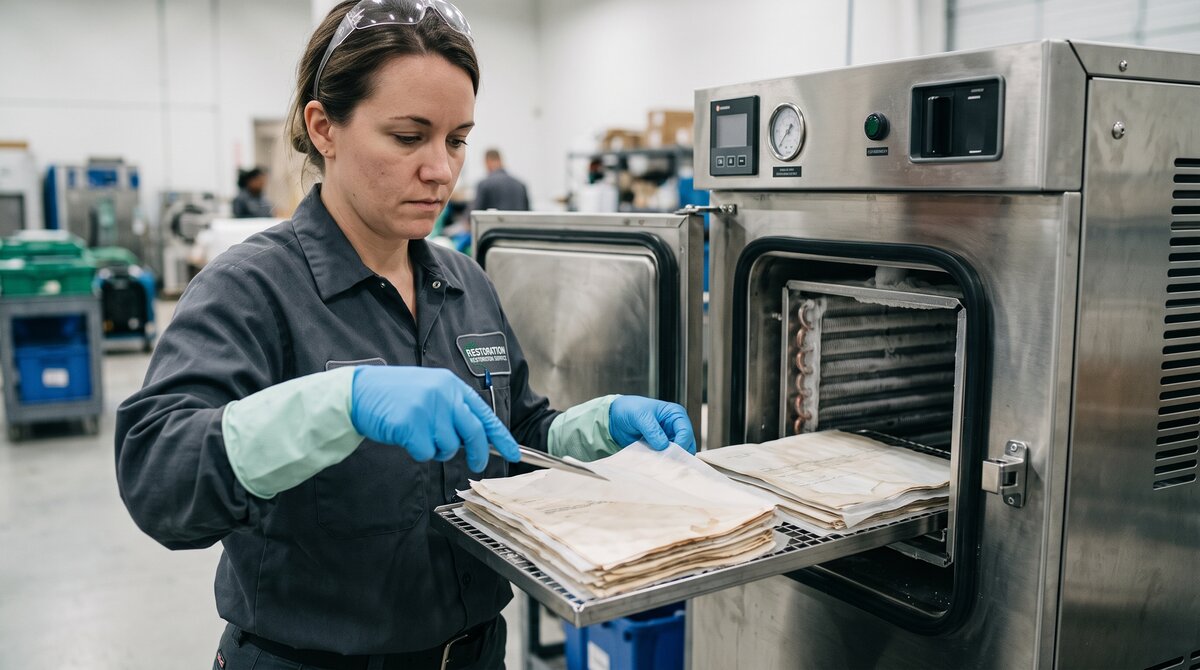
Businesses in Alberta have obligations to protect personal information, and those do not pause during a disaster. Records should be packed in sealed, labelled boxes, tracked through every step, and stored securely with limited access. Wet paper records can often be saved by freezing and freeze-drying, which stops mould and ink bleed. See document drying and restoration.
Computers, servers and equipment
Soot is corrosive and conductive, and water causes short circuits and corrosion. Powering up a smoke- or water-damaged computer can turn a restorable device into a write-off. Disconnect power, leave devices off and have them assessed. At our facility, electronics are cleaned without saturating them in water and dried and deodorized in our Electronic Drying Chamber. See electronics restoration and whether your devices can be saved after a fire.
Staff belongings and personal items
Employees often keep personal items at work: coats, bags, photos and personal electronics. Pack these separately and label them by person, so they are easy to return. Staff belongings may fall under the employees’ own home insurance rather than the business policy, so let staff know to check.
The commercial pack-out process
- Walkthrough with the owner or manager, and the adjuster where possible
- Priority list and pack-back plan agreed
- Contents photographed, labelled and inventoried by area or department
- Packing and transport on our own trucks
- Cleaning, deodorizing and restoration at our facility
- Secure, climate-controlled storage while the space is repaired
- Staged pack-back, starting with what you need to reopen
- Placement following your floor plan
Our process page shows each stage in more detail.
Reducing downtime
- Bring priority items back first and reopen in stages
- Work evenings or weekends where it helps
- Set up a temporary location with the equipment and records you need
- Keep staff and customers updated on timing
- Ask your adjuster early about business interruption and extra expense coverage
Keeping everyone informed
- Staff: when and where to work, and what to bring
- Customers: how to reach you and when you expect to reopen
- Landlord and other tenants: access, noise and loading schedules
- Insurer: priorities, timelines and any extra expenses
- Suppliers: deliveries to hold or redirect
If you lease your space
In a leased space, the landlord usually insures the building and handles its repairs, while you insure your own contents and, often, the improvements you paid for. Read your lease for who is responsible for what after a loss, and keep the landlord informed about your pack-out schedule. The restoration contractor working for the landlord will want your contents out quickly, so coordinating early avoids delays on both sides.
Commercial insurance and contents
Commercial property policies usually cover a business’s own contents, such as equipment, furniture and stock. Many businesses also carry business interruption coverage for lost income while the space is closed, and extra expense coverage for the cost of operating from somewhere else. If you lease, the landlord insures the building and you insure your own contents and, often, your improvements. Confirm the details with your broker and adjuster.
Restoring equipment and records is often faster than replacing them, which can shorten the time a business is closed.
After you reopen
- Check that restored electronics and equipment are working as expected
- Watch for odour returning on warm days or when the HVAC runs, and report it early
- Update your inventory with anything replaced
- Review your pre-loss plan with what you learned
- Confirm with your broker that coverage limits still fit the business
Planning ahead: a simple pre-loss plan
The businesses that reopen fastest usually had a plan before anything happened. It does not need to be complicated:
- A list of emergency contacts, including your broker, landlord and key suppliers
- A current inventory of equipment, furniture and stock with photos and serial numbers
- A priority list of what you need to reopen
- Off-site backups of data and important records
- A contents restoration company’s number saved where staff can find it
Our inventory checklist and template works for small businesses too.
How Calgary Contents helps businesses
We pack out, clean, store and return business contents across Calgary and the surrounding area, working alongside your restoration contractor and insurer. See commercial contents restoration, climate-controlled storage and our guide for property managers dealing with multi-unit water losses.
Frequently Asked Questions
Can a commercial pack-out happen after hours?
Often, yes. Evening and weekend work can keep part of a business running or reduce disruption for other tenants. Plan it with your contents company and building management.
Can items be returned in stages?
Yes. Critical equipment and records can come back first so you can reopen, with the rest following as areas are finished.
How are confidential records handled?
Records are packed, tracked and stored securely, with access limited to the people handling them. Tell your contents company about any privacy or regulatory requirements before the pack-out.
Can you store stock and inventory?
Yes. Restorable stock can be cleaned and held in climate-controlled storage until the space is ready. Damaged stock is documented for your claim.
Do you work with our landlord’s restoration contractor?
Yes. We regularly work alongside the contractor handling the building, so the contents and structural work are scheduled together.
How long does a commercial pack-out take?
It depends on the size of the space and how much is in it. A small office may take a day; a large retail or warehouse space can take several. Your scope will set out the plan.
Can you clean office furniture and workstations?
Yes. Desks, chairs, partitions and filing cabinets can usually be cleaned and deodorized, either on site or at our facility, depending on the damage.
Will we get an inventory of what was packed?
Yes. Every item is photographed and recorded at pack-out, and the inventory is shared with you and your adjuster.
Need to get your business back open? We plan the pack-out around what you need first. Call (403) 407-0208 any time, or contact us online.