Quick answer: Antiques and heirlooms can almost always be restored after Calgary water or fire damage if you stabilize them within the first 24 hours and don’t use household cleaners. Different materials — wood, ceramics, metal, fabric, paper — need different techniques. A contents restoration specialist combines material-specific cleaning with insurance documentation so irreplaceable items are protected on every front.
Key Takeaways
- Time is the single biggest factor in saving an antique — act in the first 24 hours.
- Never apply household cleaners, hair dryers, or direct heat to a damaged antique. They almost always make things worse.
- Different materials demand different processes: wood needs slow drying, ceramics need careful soot removal, fabrics need controlled cleaning, paper needs freezing.
- “Restoration” for a sentimental piece often means stabilization, not making it look new — patina has value.
- Insurance treats irreplaceable items differently. Document everything before triage.
- The decision between restoration and replacement isn’t just financial — it’s emotional and practical.
Table of Contents
Why Antiques and Heirlooms Need Specialist Care
A century-old wedding photograph, your grandmother’s walnut sideboard, a great-uncle’s violin, a hand-painted china set — the objects we call “heirlooms” share one thing in common: they were never built for the cleaning processes most contents companies use. Modern furniture is engineered to survive an aggressive rinse. A 19th-century veneered cabinet is not.
When water, smoke, or soot reaches an antique, three problems start at once. Materials swell or shrink at different rates — veneer lifts off the substrate, ceramic glazes craze, fabrics tighten and tear. Reactive chemistry kicks in — soot becomes increasingly acidic the longer it sits on a surface, etching brass, oxidizing silver, and yellowing finishes. And biological activity starts — mould loves the gelatin, hide glue, and natural fibres that hold older objects together.
Specialist care means three things working together: stabilization first (stop the damage clock), material-appropriate cleaning (no one-size-fits-all chemistry), and documentation alongside every step so your insurance claim isn’t a fight. Calgary Contents’ broader framework for the restore-vs-replace decision is laid out in our contents restoration vs. replacement guide — and it’s especially relevant when the “item” in question is one you can’t actually replace.
First 24-Hour Triage After Water Damage
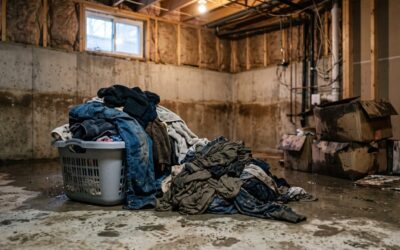
If a basement flooded, a roof leaked, or a sprinkler discharged onto an antique, the first 24 hours determine almost everything. Here’s the order of operations.
- Document everything first. Phone photos and short video clips, wide and close. Capture serial numbers, maker’s marks, signatures, and provenance documents in the same shot if possible.
- Move items out of standing water. Carry by structural support, never by handles, knobs, or veneered surfaces. Place on raised plastic sheeting in a cool, dry room.
- Don’t wipe. Surface moisture on antiques is best removed by gentle blotting with white absorbent towels, not rubbing. Rubbing pushes water into the grain and removes finish.
- Stabilize the environment. Keep ambient temperature between 15–20°C and humidity around 45–55%. Dehumidifiers and fans — pointed away from objects, not at them — are essential.
- Separate by material. Wood, metal, ceramic, fabric, and paper all have different sensitivities and rates of damage. Triaging by material lets you prioritize the items at highest risk.
- Don’t put anything in the freezer except paper and photos. Many homeowners try to “pause” everything by freezing. That works for paper. It cracks ceramics, splits wood, and damages photographs differently than you’d expect.
For broader guidance on what your contents may or may not recover from, see our breakdown of the top 5 signs your belongings can be restored after water damage.
First 24-Hour Triage After Fire and Smoke
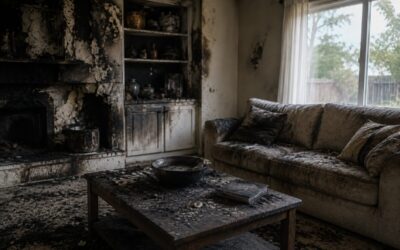
Fire damage is different from water damage in one crucial way: the longer soot sits, the more acidic it becomes, and the more it etches into porous and reactive surfaces. Twenty-four hours of soot exposure on brass can leave permanent discolouration. A week can ruin it.
The triage rules are:
- Don’t touch soot with bare hands. Skin oils combined with soot create a far worse stain. Wear nitrile gloves.
- Don’t vacuum upholstered antiques. A standard vacuum drives soot deeper into the fabric. Specialty HEPA equipment is required.
- Don’t wash anything with water. Many surface-cleaning instincts backfire on antiques — water plus soot creates an acidic slurry that can stain finishes, etch metals, and fix odours into porous materials.
- Ventilate carefully. Get air moving through the room, but don’t blast cold outdoor air across delicate finishes — rapid humidity swings crack veneer.
- Bag obviously contaminated soft goods. Drapes, throws, and small textile items go into sealed plastic bags labelled by room — this prevents cross-contamination and helps your restoration team triage.
For more on what fire smoke does to belongings and how decisions get made, our article What Can and Can’t Be Saved After Smoke Damage goes deeper.

Restoration Techniques by Material
This is where antique restoration genuinely diverges from general contents cleaning. Each material category has its own playbook.
| Material | Primary risk | Typical professional technique |
|---|---|---|
| Wood & veneer | Swelling, veneer lift, joint failure, finish blanching | Slow controlled drying, hide-glue re-adhesion, hand-rubbed finish restoration |
| Ceramics & glass | Glaze crazing, soot adhesion, hairline cracks from rapid temp change | Cotton-swab cleaning with pH-neutral solutions; ultrasonic for sturdy pieces |
| Metal (silver, brass, iron) | Tarnish, soot etching, oxidation, electrolytic corrosion | Metal-specific chemical baths, controlled buffing, microcrystalline wax sealing |
| Textiles & upholstery | Dye bleeding, fibre weakening, mould, smoke odour penetration | Spot cleaning, controlled wet-cleaning, ozone treatment for odour |
| Paper, books & photos | Stuck pages, ink bleeding, mould, dimensional warping | Freezing to pause, freeze-drying, humidity chambers, conservation-grade reflattening |
| Leather | Shrinkage, cracking, mould, irreversible stiffening if dried too fast | Slow drying with conditioners, soft brushing, hand-rubbed restoration |
Some items combine three or four of these materials in a single piece — an antique armchair has wood, fabric, possibly leather, and metal hardware. The restoration plan accordingly is layered: a different process for each material, sequenced so one step doesn’t undo another.
When Replacement Is the Better Call
Sometimes the honest professional answer is “you can’t bring this one back.” The hardest part of heirloom restoration is calling that line clearly. A few signals it’s time to consider replacement or reproduction:
- Substrate failure. If the underlying wood is delaminating, structurally rotted, or fire-charred through, no surface restoration will hold up over time.
- Cost vs. emotional value. If restoration would cost 3× the replacement value AND there’s no irreplaceable sentimental component, replacement is often more responsible.
- Health risks. Items contaminated with sewage, lead paint deep into wood grain, or asbestos-containing finishes may need to be deaccessioned for safety reasons.
- Compromised structure on items used daily. A century-old dining chair you actually sit on must be structurally sound — restoration that looks beautiful but fails under load isn’t a restoration.
Our deeper article on this topic, Understanding Non-Restorable Items, walks through the decision framework in more detail.
Working With Insurance on Irreplaceable Items
Antiques and heirlooms are a known problem area for residential insurance claims because their value isn’t straightforward. Most Alberta homeowner policies have sub-limits for “valuable articles” categories — jewellery, fine art, antiques, and collectibles — that cap how much standard contents coverage will pay out without a separate scheduled endorsement.
Before disaster strikes, the protective move is to maintain a scheduled antiques rider with appraisals on file. After disaster strikes, the protective moves are: document everything (photos, video, provenance), don’t throw anything away (your adjuster needs to see it), and bring in a restoration partner whose paperwork your insurer recognizes. The Insurance Bureau of Canada’s consumer materials on filing residential claims (ibc.ca) are a useful primer on what adjusters need.
The Calgary-specific walkthrough on filing the claim is in How to File an Insurance Claim for Damaged Contents in Alberta, and our broader pack-out process is detailed in The Complete Guide to Contents Pack-Out Services in Calgary.

How Calgary Contents Approaches Heirloom Restoration
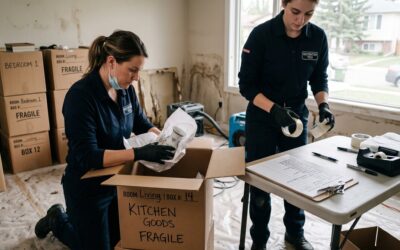
Our heirloom workflow looks different from a standard contents job in three ways. First, we pre-document. Before anything is moved or cleaned, each piece is photographed, condition-graded, and the maker’s marks recorded. This becomes the baseline both for our restoration plan and for your insurance file.
Second, the cleaning is hand-led, not equipment-led. Where general contents cleaning leans on ultrasonic baths and fogging chambers, heirloom work leans on conservation-grade hand techniques. Ultrasonic still plays a role for sturdy ceramics and metals (see our explanation of ultrasonic cleaning for delicate items), but the operator is the variable that matters, not the machine.
Third, the goal is stabilization with sympathy, not refinishing. A restored heirloom isn’t a piece that looks new — it’s a piece that’s structurally sound, biologically clean, and as visually consistent with its pre-disaster condition as possible. Patina has value. Visible repair often does too.
For households where the disaster also involved smoke odour penetration into fabric pieces, our team also coordinates ozone and HEPA-filtration treatments — the methodology is laid out in our article on odour removal and decontamination.
Frequently Asked Questions
How quickly do I need to act after my antique is damaged?
Within 24 hours for water damage and 24–48 hours for fire and smoke. Beyond those windows the damage becomes much harder to fully reverse — soot turns acidic, mould begins, and wood joints weaken. Calling a restoration team within the first day usually means the difference between full recovery and partial loss.
Will restoration affect the value of an antique?
Conservation-grade restoration generally preserves or restores value because it stabilizes the piece without altering it cosmetically. Aggressive refinishing — stripping original surfaces, replacing original hardware — can permanently reduce value. A reputable conservator will discuss this trade-off with you before any work begins.
Are restoration costs covered by Calgary insurance policies?
Generally yes, under contents or personal-property coverage, but valuables sub-limits and scheduled endorsements often apply. Speak with your broker about scheduling high-value antiques specifically — this is the single most important pre-disaster step for heirlooms.
What if multiple pieces are damaged in one event?
That’s typical after a fire or major flood. The restoration team triages by material sensitivity and condition severity, working the most urgent items first while stabilizing the rest. A full pack-out (where everything moves to a controlled-environment facility) is often more efficient than on-site work for big multi-item losses.
Can you restore an antique I’ve already tried to clean myself?
Often yes — well-meaning attempts with household cleaners are common and rarely fatal. Tell your restorer exactly what you used; that lets them choose follow-up chemistry that won’t conflict. The worst-case scenarios involve coloured cleaners, ammonia-based products, and abrasive sponges, but even those can usually be worked with.
Do you restore items that have been in storage for years and are now moldy?
Yes — mould remediation on antiques is a common parallel service. The remediation has to happen before any restoration work, otherwise spores get spread and cleaning effort gets wasted. For background, see our piece on mould protection for belongings after water damage.
Need an antique or heirloom evaluated? The first 24 hours after damage matter most. Schedule a heirloom assessment with Calgary Contents — we’ll triage, stabilize, and document everything for both restoration and insurance.