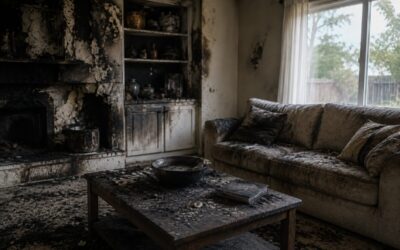
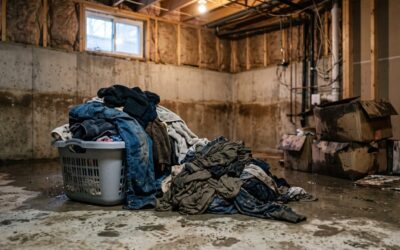
You wake up at 2 a.m. to the sound of running water — except no taps are open. By the time you find the source, water is pouring through the basement ceiling, your finished family room is soaked, and the smell of wet drywall is already settling in. A frozen pipe burst Calgary homeowners experience every single winter is one of the most destructive events a home can suffer, and the contents inside — your photo albums, electronics, upholstered furniture, kids’ artwork, family heirlooms — are usually hit harder than the structure itself. The choices you make in the first 24 hours often decide whether those belongings can be saved or have to be written off as a total loss.
This guide walks Calgary homeowners through exactly what to do after a frozen pipe bursts, what gets damaged first inside your home, how to document your belongings properly for an Alberta insurance claim, and when to bring in a professional contents cleaning and restoration team. We’ll cover what’s salvageable, what isn’t, and the small mistakes that cost homeowners thousands when they try to handle wet contents on their own.
Table of Contents
- Why Calgary Homes Are Especially Vulnerable to Frozen Pipe Damage
- The First 24 Hours After a Frozen Pipe Burst in Calgary
- What Gets Damaged First (and What You Can Often Save)
- Documenting Your Belongings for an Alberta Insurance Claim
- Why DIY Drying Often Makes the Damage Worse
- When to Call a Professional Contents Restoration Team
- Recovery Timeline: How Long the Process Actually Takes
- Frequently Asked Questions
- Save Your Memories Before Mould Sets In
Why Calgary Homes Are Especially Vulnerable to Frozen Pipe Damage
Calgary’s climate is uniquely harsh on residential plumbing. Temperatures can swing from a mild Chinook of +10°C down to −30°C inside of 48 hours, and that rapid freeze-thaw cycle puts more stress on copper, PEX, and galvanized steel pipes than a steady cold ever would. When water inside a pipe freezes, it expands by roughly 9% in volume, generating internal pressure that can exceed 2,000 PSI — far more than any residential pipe is built to withstand.
What surprises most Calgary homeowners is that the pipe rarely bursts at the frozen blockage itself. Pressure builds between the ice plug and a closed faucet downstream, so the actual rupture often happens inside a wall, ceiling cavity, or behind a kitchen cabinet — somewhere you can’t see. By the time water shows up on the floor, gallons have already been pumped into your insulation, drywall, subfloor, and stored belongings.
Older Calgary neighbourhoods like Bridgeland, Mount Pleasant, Inglewood, Hillhurst, and Killarney face higher risk because of shallower water service depths and original galvanized plumbing. Newer suburban builds in Cochrane, Airdrie, and Chestermere aren’t immune either — exterior wall plumbing in basements and bonus rooms freezes quickly when furnaces struggle during a deep cold snap. A single burst pipe can release four to eight gallons of water per minute, which means a basement can flood in under an hour while you’re at work.
The First 24 Hours After a Frozen Pipe Burst in Calgary
What you do in the first day after a frozen pipe burst Calgary basement or main-floor flood almost always determines whether your belongings can be restored. Here’s the order that matters most.
Step 1 — Shut off the water and the power
Locate your main shut-off valve (usually near the water meter in your utility room) and turn it clockwise until water stops. If water is anywhere near electrical outlets, your panel, or appliances, switch off the breakers feeding those circuits before stepping in. Standing water plus live electricity is the most common avoidable injury in burst-pipe scenarios.
Step 2 — Open faucets and call your insurer
Open the closest faucets to drain remaining pressure from the line. Then call your insurance company immediately to report the loss — most Alberta policies require prompt notification, and waiting can complicate your claim. Ask whether you should call a restoration company directly or wait for an adjuster’s go-ahead. In urgent water-loss situations, mitigation almost always starts before the adjuster arrives.
Step 3 — Photograph everything before you move it
Before you start dragging soaked items out of the room, take photos and video of every affected surface, room, and possession. Capture serial numbers on electronics, brand labels on furniture, and any visible water lines on walls. This documentation is the backbone of your contents claim, and rebuilding it from memory after the fact is nearly impossible. If photographing thousands of items feels overwhelming, a professional photo inventory service can take this off your plate.
Step 4 — Move what you can to dry, ventilated space
Once the room is documented, lift soaked items off the floor. Stand wet books on end, separate stacked photos, drape wet clothing over plastic hangers, and get porous items into a heated room with airflow. Don’t pile soaked things on top of dry ones — moisture transfers, and you’ll just create a second wave of damaged belongings.
What Gets Damaged First (and What You Can Often Save)
Not every wet item is a write-off. The key variable is time — specifically, how long water sits in contact with each material before drying or professional cleaning starts. After about 24 to 48 hours of saturation, mould begins forming on porous surfaces, and what could have been a cleaning job becomes a disposal job.
| Item Category | Damage Window | Typically Salvageable? |
|---|---|---|
| Hardwood furniture | 24–48 hours | Yes, if dried quickly and refinished |
| Upholstered furniture | 24–48 hours | Sometimes — depends on fill and frame |
| Mattresses & pillows | 12–24 hours | Rarely — porous and impossible to dry through |
| Clothing & textiles | 24–72 hours | Usually yes, with professional laundering |
| Books & paper documents | 12–24 hours | Yes, if frozen or freeze-dried promptly |
| Photographs (printed) | 2–48 hours | Yes, if separated and air-dried within 48 hrs |
| Electronics & appliances | 0–24 hours | Often yes, if powered off and never re-plugged |
| Particleboard / IKEA furniture | 6–12 hours | Rarely — swells and disintegrates |
| Drywall & insulation | 24–48 hours | Replaced, not restored |
The strongest predictor of whether something survives is how fast a professional dry-out and contents pack-out begins. Items that get into our climate-controlled facility within 48 hours have dramatically better outcomes than items left to sit in a damp basement waiting for the adjuster to call back. If you’re unsure what’s worth saving, our team has covered the topic in more detail in our guide on the signs your belongings can be restored after water damage.
Documenting Your Belongings for an Alberta Insurance Claim
Most Alberta home insurance policies cover sudden and accidental water damage from frozen and burst pipes, but the contents portion of your claim is where homeowners leave the most money on the table. Insurers require a Proof of Loss form listing every damaged item — description, brand, age, original purchase price, and replacement cost. Producing that list under stress, with kids displaced and the basement still wet, is genuinely brutal.
Two policy details to confirm with your broker right now:
- ACV vs. RCV coverage: Actual Cash Value pays the depreciated value of an item. Replacement Cost Value pays what it costs to buy a new equivalent today. The difference on a five-year-old TV or sectional can easily run into the thousands.
- Additional Living Expenses (ALE): If your home is uninhabitable, ALE covers hotel, restaurants above your normal grocery budget, laundry, pet boarding, and storage. Most Alberta policies set ALE at 20–30% of dwelling coverage. Save every receipt.
For a deeper walkthrough of the Alberta-specific paperwork, see our existing post on how to file an insurance claim for damaged contents in Alberta. A professional contents restoration company can also work directly with your adjuster to handle scope, estimates, and salvage decisions, which removes most of the back-and-forth from your day.
Why DIY Drying Often Makes the Damage Worse

The instinct after a flood is to grab a Shop-Vac, point a fan at the wet stuff, and start drying. We understand the impulse — the problem is that residential drying tools simply can’t reach the moisture levels professional equipment is built for, and partial drying is worse than no drying at all.
Three of the most common — and most expensive — DIY mistakes we see in Calgary homes:
- Using household fans on saturated upholstery. Surface dries, interior stays wet, mould grows in the foam within a week, and the smell never leaves.
- Plugging in wet electronics to “see if they still work.” Even if they boot up once, mineral residue from tap water continues corroding circuit boards for months. Our electronics restoration cleaning process flushes those residues before damage progresses.
- Stacking wet books or photos to dry. Pages fuse together permanently. Photos must be separated and air-dried face-up within 48 hours, or the emulsion sticks and the image is lost.
The other risk is hidden moisture. Water travels along framing, soaks subflooring, and wicks up the back of furniture you didn’t even realize was affected. Industrial moisture meters and thermal imaging — which restoration companies use as standard practice — find pockets of saturation that look completely dry to the eye.
When to Call a Professional Contents Restoration Team
Call a professional contents restoration team as soon as the water is shut off and you’ve notified your insurer — not days later, after you’ve tried to handle it yourself. Restoration companies operate on a triage clock, and every hour of delay shifts more of your belongings into the unsalvageable column. At Calgary Contents, our crews can typically be on site the same day for emergencies anywhere from downtown Calgary out to Cochrane, Airdrie, and Rocky View County.
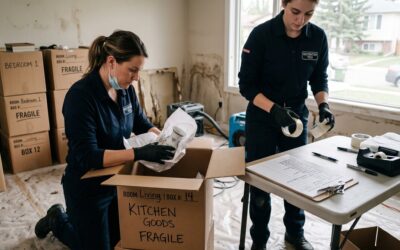
A professional pack-out looks like this: every affected item is photographed and barcoded, packed into protective crates, transported to a climate-controlled cleaning facility, dried using calibrated equipment, then individually cleaned using the right method for the material — ultrasonic baths for hard non-porous goods, specialized laundering for textiles, controlled dry cleaning for delicates, and dedicated processes for documents and electronics. Anything we can’t restore is documented as a non-restorable for your claim. The complete contents pack-out service page walks through every stage in detail.
While your contents are being restored at our facility, your home can be properly dried, structural repairs can happen without contents in the way, and your belongings come back cleaner than they left. We pack everything back into your home once it’s habitable again — that’s the “pack-back” part of the service.
Recovery Timeline: How Long the Process Actually Takes
Most Calgary homeowners drastically underestimate how long contents restoration takes — partly because adjusters give optimistic estimates, partly because the process has more stages than people realize. Here’s a realistic breakdown for a typical frozen-pipe basement flood:
| Phase | Typical Duration | What’s Happening |
|---|---|---|
| Emergency mitigation | Day 1–3 | Water extraction, structural drying, contents triage |
| Pack-out | Day 2–4 | Inventory, photo documentation, packing, transport |
| Cleaning & restoration | Week 2–6 | Drying, ultrasonic, laundering, electronics, deodorization |
| Storage | Concurrent with home repairs | Climate-controlled warehouse storage |
| Pack-back | 1–2 days | Return delivery and placement when home is ready |
| Total typical timeline | 4–10 weeks | Varies with damage severity and structural repairs |
For complex losses — basements with mould already established, multi-room saturation, or large heirloom collections — the timeline can stretch to 12 weeks or more. The single biggest variable is how quickly the contents pack-out starts, which is why we push so hard on day-one calls.
Frequently Asked Questions

Will my home insurance cover a frozen pipe burst in Calgary?
Most standard Alberta home insurance policies do cover sudden and accidental water damage from a frozen pipe burst, including both structural and contents damage, minus your deductible. Coverage may be reduced or denied if the home was unheated or unattended for an extended period. Always confirm specifics with your broker, and review your policy for ACV vs. RCV coverage on contents.
How long do I have before water-damaged belongings start growing mould?
Mould can begin developing on porous, saturated materials within 24 to 48 hours under normal indoor conditions. The countdown is faster in warm, humid environments and slower in cool basements, but you should not assume you have more than two days. This is the single biggest reason contents restoration companies treat water losses as time-sensitive emergencies. For more on this, see our guide on protecting belongings from mould after water damage.
Can wet electronics be saved after a frozen pipe flood?
In many cases yes — provided they are powered off immediately, never plugged back in, and sent to a professional electronics restoration team within a few days. Tap water leaves mineral residues on circuit boards that continue corroding long after the device looks dry, so the cleaning matters more than the drying.
What about photo albums and family documents?
Wet photographs need to be separated within 48 hours and air-dried face-up on a clean surface. If you can’t get to them quickly, place them in a freezer in zip-top bags — freezing buys you weeks before professional restoration. Documents respond well to the same approach. Our team handles freeze-dry restoration for both photos and paper records.
Should I move my belongings out myself or wait for the restoration company?
Lift items off the floor, separate wet from dry, and move clearly damaged items to a heated room with airflow — that buys time. Don’t try to do a full-scale move. Heavy wet furniture, electronics, mattresses, and items requiring special handling are better left to a professional pack-out crew, both for documentation purposes and to avoid further damage.
Do you serve Airdrie, Cochrane, and surrounding communities?
Yes. Calgary Contents serves Calgary plus Airdrie, Rocky View County, Beiseker, Chestermere, Cochrane, Crossfield, and Irricana. You can find your local service area on our locations page.
Save Your Memories Before Mould Sets In
A frozen pipe burst Calgary winter delivers can take a basement from finished to flooded in under an hour, but with the right response in the first 24 to 48 hours, the vast majority of your belongings can come home cleaner than they left. The decision that matters most is how quickly you bring in a contents restoration team that’s trained for this specific kind of loss.
Calgary Contents has spent more than 20 years restoring belongings damaged by water, fire, smoke, mould, and odour — over 25,000 contents recoveries across Calgary and the surrounding communities. We work directly with your insurance adjuster, handle photo inventory, pack-out, ultrasonic cleaning, electronics restoration, and pack-back, and we treat every item as if it were our own. Our motto is simple: Save Your Memories…One Item at a Time.
If a frozen pipe has burst in your home, call us right now at (403) 407-0208 or reach out through our contact page. The faster we’re on site, the more we can save.
Related Resources
- Top 5 Signs Your Belongings Can Be Restored After Water Damage
- How to Protect Your Belongings from Mould After Water Damage in Calgary
- How to File an Insurance Claim for Damaged Contents in Alberta
- Contents Restoration vs. Replacement: What Calgary Homeowners Need to Know
- Water and flood damaged belongings
- Document drying and restoration
- Textile and clothing restoration
- Climate-controlled storage